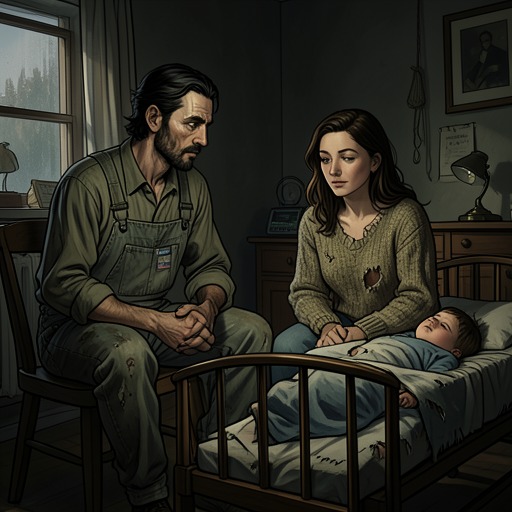
Paul(Father)
Klara and the SunPaul(Father) is Josie’s father and a restrained, practical presence in the family’s life. He helps care for Josie through serious illness, supports Rick’s talents despite the stigma attached to Rick’s unlifted status, and places his trust in Klara during the effort to save Josie. His actions are often quiet rather than declarative: he questions the Mother when Josie behaves strangely, offers Rick encouragement, and, without knowing Klara’s agreement with the Sun, helps her pursue the hope on which she has staked Josie’s life.
Identity and Family Life
Paul is married to the Mother and is Josie’s father. The available scenes show him within a family whose ordinary routines and strained relationships are shaped by Josie’s illness. He is not present in every intimate exchange: the Mother usually manages the daily rhythm of getting Josie to breakfast, while Melania Housekeeper and Klara share much of the immediate work of care. Yet Paul’s concern emerges when the family’s arrangements are threatened or when Josie’s condition becomes more precarious.
The morning coffee routine illustrates what the household is trying to preserve. Josie is often reluctant to get up in time to join the Mother, and Klara learns that missing this brief shared moment can leave Josie vulnerable to loneliness despite the other events in her day. Paul is not described as participating in that particular routine, but the episode establishes the domestic circumstances surrounding his family: illness makes even a quick coffee together consequential, and care depends on attention to the small occasions that keep Josie connected to her mother.
Care During Josie’s Illness
On the planned trip to Morgan’s Falls, Paul’s concern takes the form of firm scrutiny. When Melania Housekeeper suggests that Josie is well enough to spend the day out, he asks whether this is really her assessment and says it gives him concern about her. He then challenges Melania when she does not get out to help Josie disembark. His intervention makes the disagreement about the outing more than a difference of opinion: Josie’s wishes matter, but so does the adults’ responsibility to judge the risks of her illness and assist her physically.
When the trip is abandoned, Josie apologizes to Klara and promises they will go another time. Klara answers that they must do what is best for Josie. The exchange leaves the disappointment intact while placing Josie’s health above the planned outing. Paul’s questioning of the housekeeper belongs to this same protective context, even though the account does not say that he alone decides what happens next.
Later, as Josie’s condition worsens, the Mother and Dr Ryan repeatedly debate whether she should go to hospital. They ultimately agree that hospital would add to her misery, but revisit the question each time the doctor comes. The adults’ hours become irregular as they sleep only when exhaustion overtakes them. Rick visits daily and takes a turn sitting beside Josie while the Mother and Melania Housekeeper rest. Paul’s role is not included in this description of the bedside rota; the scene nevertheless clarifies the wider strain on Josie’s family and the limits of relying on any one caregiver.
Trust and Responsibility in the Crisis
Paul’s trust in Klara is especially consequential because he does not know the terms on which she acts. Klara believes she has made an agreement with the Sun: in return for its special nourishment for Josie, she must stop the pollution caused by the Cootings Machine. When she later asks the Sun to help Josie, she acknowledges that Paul helped her and did his utmost, though he knew nothing of the agreement. She understands his cooperation as an act of faith in her hope, not as participation in her religious bargain.
That distinction gives Paul’s contribution its particular weight. He does not share Klara’s explanation of events, and the evidence does not present him as knowing what she has promised or expecting the same outcome. He nevertheless helps her effort, trusting what she sees and hopes for. Klara’s request to the Sun also takes responsibility for the failure to prevent pollution upon herself; she insists that Josie is innocent and asks that her father’s part be recognized as wholehearted help despite his ignorance of the bargain.
The Children’s Futures and Recognition
Paul also appears in the family’s attempts to secure Rick’s future. Helen explains that Rick was meant to be home-tutored by screen professors, but the plan became complicated: members of TWE are forbidden to tutor unlifted children, while other tutors demand fees the family cannot afford. Atlas Brookings admits a small number of unlifted students, making admission a rare possibility rather than an assured route. Helen believes Rick is clever enough to compete if he applies himself and receives expert guidance, and she sees Klara’s arrival next door as an opportunity to help him.
At a family gathering, Paul responds directly to Rick’s drone work. He calls it impressive and exciting, adding that genuine ability ought to be noticed whether a person is lifted or not. The remark links his encouragement to the injustice Rick faces: formal status can restrict educational opportunities, but Paul refuses to treat that status as a measure of Rick’s capacity. Rick credits Paul with having encouraged him when he first became interested in drones and with having helped lay the foundations of the work on display. Paul modestly denies that he contributed much, while accepting Rick’s thanks. Their exchange presents support as something that may matter deeply to its recipient even when the person offering it does not claim credit.
Paul’s later family conversations also register the emotional consequences of changing futures. Klara observes that Rick and Josie remain kind to one another even as they prepare for different lives. Paul recalls an earlier conversation in which she asked whether his love for Josie was genuine; he had answered that it was real and everlasting. His memory makes the contrast between enduring affection and diverging plans explicit. It does not resolve what their future relationship will become, but it shows that Paul recognizes the question of love as important to Klara’s unease.
Conflict, Change, and Narrative Significance
Paul’s relationship with the Mother is not presented as uncomplicated. During the city visit, he challenges her over Josie’s strange behavior and asks whether she has told their daughter something. The Mother denies having explained all of it, though her uncertain reply leaves the precise subject unstated. The exchange exposes tension between the parents about what Josie knows and what she should be told, without establishing the full content of their disagreement.
After an emotionally difficult night involving Helen and Vance, the Mother speaks more sympathetically of Paul, saying that she may sometimes be too hard on him and that she feels sorry for him. This is a small but telling change in how she describes her husband: rather than turning the scene into a resolution, the narrative offers a moment of softened judgment. Their relationship appears amid several unresolved pressures, including Josie’s illness and the adults’ uncertainty about what to disclose.
Paul’s most decisive contribution remains his practical participation in Klara’s attempt to protect Josie, undertaken without knowledge of its supernatural terms. The novel gives this support a double meaning: for Paul it is help offered in response to Klara’s hope, while for Klara it becomes evidence that another person has placed faith in the course she has chosen. Alongside his defense of Rick’s ability and his presence in a family organized around Josie’s fragile health, Paul embodies a form of care that is substantial without being omniscient. He cannot control the children’s futures or remove their constraints, but he can recognize talent, question decisions that concern Josie, and act when someone asks him to trust.